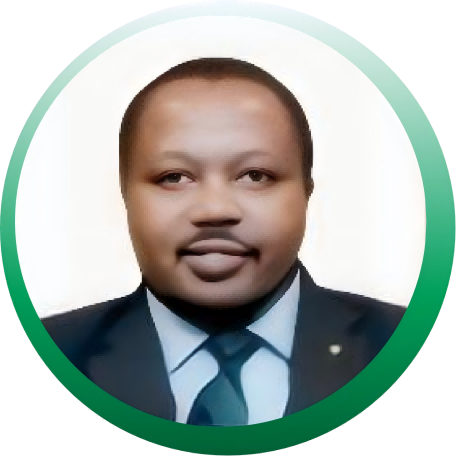
Francis Mwangi
The Vice Chair of the ICAO Committee on Aviation Environmental Protection ; Principal Planning Officer, Kenya Civil Aviation Authority
Speech Title:
ICAO’s Environmental Policy and the SAF Supply Chain: Challenges and Opportunities in Africa
Biography
Francis is an accomplished environmental expert and Principal Planning Officer at the Kenya Civil Aviation Authority (KCAA), with over 19 years of experience in environmental management, aviation policy, and climate change. Since 2015, he has served as Kenya’s focal point for aviation greenhouse gas (GHG) emission reduction, climate change initiatives, CORSIA, and Sustainable Aviation Fuel (SAF) programmes. He is the Kenya Nominated CAEP Member and since November 2023, he has been the Vice-Chairperson of the International Civil Aviation Organization’s (ICAO) Committee on Aviation Environmental Protection (CAEP). He has represented Kenya in high-level environmental negotiations under the United Nations Framework Convention on Climate Change (UNFCCC) and ICAO, contributing to the development of Kenya’s Aviation Action Plan for CO₂ reduction and supporting SAF feasibility and business implementation studies undertaken in 2018 and 2025.
His research focuses on SAF value chain challenges in Africa, the impacts of climate change on aviation, and environmental economics. Francis has also provided leadership within the African Civil Aviation Commission (AFCAC), serving as Chairperson of its environmental working groups from 2019 to 2023, and as a Co-facilitator under the UNFCCC on bunker fuels and CO₂ emissions from international aviation and maritime transport. He holds a First-Class Honours B.Sc. in Mathematics, an M.Sc. in Finance, and an M.A. in Economics from the University of Nairobi, and is currently pursuing a Ph.D. in Applied Economics at Hasselt University, Belgium, specialising in environmental economics with a focus on SAF value chain challenges in Africa.
His research focuses on SAF value chain challenges in Africa, the impacts of climate change on aviation, and environmental economics. Francis has also provided leadership within the African Civil Aviation Commission (AFCAC), serving as Chairperson of its environmental working groups from 2019 to 2023, and as a Co-facilitator under the UNFCCC on bunker fuels and CO₂ emissions from international aviation and maritime transport. He holds a First-Class Honours B.Sc. in Mathematics, an M.Sc. in Finance, and an M.A. in Economics from the University of Nairobi, and is currently pursuing a Ph.D. in Applied Economics at Hasselt University, Belgium, specialising in environmental economics with a focus on SAF value chain challenges in Africa.
Abstract
The presentation will outline ICAO’s environmental policy framework for reducing aviation emissions and examine the role of Sustainable Aviation Fuels (SAF) in achieving global decarbonisation goals. It will focus on SAF supply chain challenges in Africa, including feedstock availability, financing, infrastructure, affordability, and policy support. The presentation will also highlight the opportunities and socio-economic benefits of SAF production, such as job creation, energy security, industrial development, and sustainable economic growth across the continent.